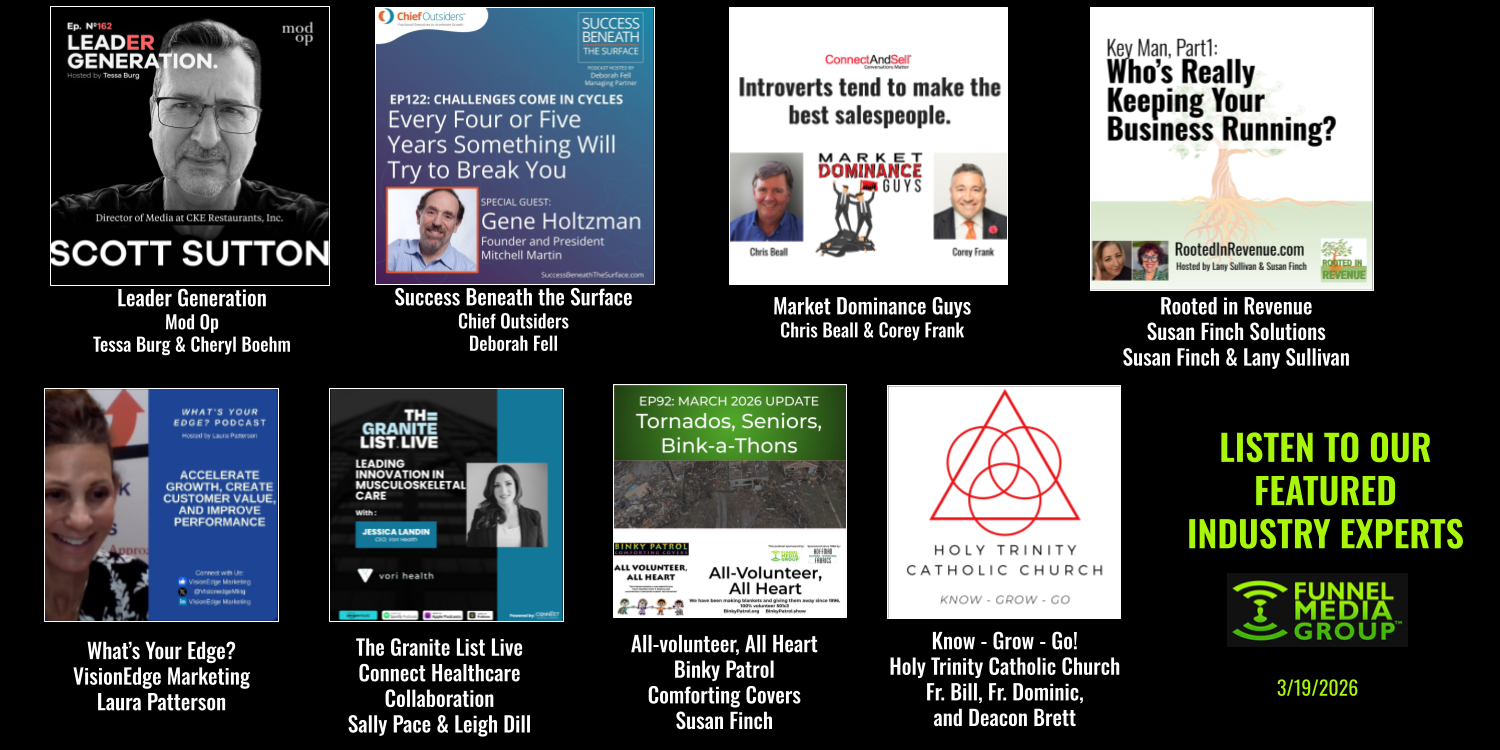
Ever feel overwhelmed by all the data and metrics coming your way? You’re not alone. In this episode of Leader Generation, Tessa Burg talks with Scott Sutton about one of marketing’s biggest challenges: figuring out what’s actually worth measuring. Scott shares real-world insights from his experience managing media for major restaurant brands like Hardee’s and Carl’s Jr. You’ll discover why measuring everything can actually hurt your marketing efforts, how to identify the metrics that truly matter to your business and practical strategies for getting leadership buy-in on your measurement approach. This conversation is packed with actionable advice for anyone trying to cut through the noise and focus on outcomes that drive real business growth.
Gene Holtzman didn’t start out in staffing. He started in the South Bronx, working with drug addicts and unemployed people in the late 1970s, building nonprofits and figuring out how to help people find work. When Reagan-era budget cuts pulled the rug out in 1982, he had a decision to make. He was 31 years old with two kids, and he chose to bet on himself. That bet became Mitchell Martin, a technology and healthcare staffing firm Gene co-founded on Wall Street in 1984. Today the company runs close to $180 million in revenue and employs staffing professionals, contractors, and a team of 75 in India. They’ve survived the 1987 crash, 9/11 (they were three blocks away and couldn’t get to their office for six months), COVID, and the current market contraction. In this conversation, Gene talks with Deborah Fell about what it actually looks like to run a company for over 40 years with the heart of a social worker. He gets into the decision to become an ESOP, why he walked away from what would have been a much larger exit, how he’s handling fraud detection with AI tools like Ropes AI, and where he sees the staffing industry heading as AI reshapes the job market.
Most business owners think they know who the key person in their organization is. They think of the CEO, the founder, the executive. But Susan Finch and Lany Sullivan have a different perspective, and once you hear it, you cannot unhear it.In this episode, Lany opens with a concept borrowed from the insurance world: Keyman Insurance, which is an actual policy that protects a business when something happens to a critical individual. But what the insurance industry focuses on and what actually keeps your day-to-day operations alive are often two very different things. The real key people in your business are rarely at the top of the org chart.
Susan and Lany walk through what happens when a business loses that person: the front desk admin who handled all invoicing, the ops coordinator who held every password, the team member who just knew things no one else thought to document. One HR company Lany references lost their key person and had no passwords. No access. No continuity. The business scrambled. The conversation shifts to prevention. Where does all the knowledge live? Is there a hub, a Start Here folder, a documented set of SOPs that would allow someone to step into a role and keep things moving? For smaller businesses especially, under 15 people, cross-functionality is not optional. It is survival.
They cover how to start: build the hub first, then work department by department or person by person to identify what everyone is actually doing. Lany shares how she developed full job descriptions for a nonprofit education client before even touching SOPs, because no one had clearly defined what each person was responsible for. Susan introduces the Peanut Butter and Jelly method for documentation, the practice of writing every step as if explaining it to someone who has never done it, never used the software, never seen the interface. A process you think has five steps almost always has twenty-five when you write it out properly. The episode closes with action items: go back into your business, ask your team who they think the key person is, and see if the answers match. Then start imagining what a two-month absence from that person would do to your clients, your vendors, and your operations cycle. That discomfort is your starting point.
Marketing can step in and help sales overcome it. 1. Beginning: listen to discovery conversations. 2. Middle: look at support tickets to see the unvarnished truth. 3. End: work on getting the pipeline to be seen as an asset, it belongs on the balance sheet. Ask to be measured on the value we are contributing to help steer my efforts based on results that are being produced. 1. I want to know upfront what’s going on – attribution 2. in the middle – discovery 3. at the end – support tickets and we should want to know this first hand.
In this update episode, founder Susan Finch shares what Binky Patrol chapters are doing right now, from sending handmade blankets to tornado victims in Illinois and Indiana (in partnership with Reach Out Worldwide) to launching the Active Seniors campaign, expanding Greek life events in Connecticut and Oregon, and preparing for Bink-A-Thon in October. The official 30th anniversary lands on June 19th — the date Binky Patrol went national, time zone by time zone, when it appeared on the Oprah Winfrey Show for National AIDS Awareness Day. Susan gives a shout-out to author Jennifer Chiaverini, whose book Round Robin from the Elm Creek Quilts series is part of their celebration reading list.The Bink-A-Thon, sponsored by the Mr. Ballen Foundation, is ramping up. And Mr. Ballen himself is heading out on a live storytelling tour this summer — including a stop in Portland, which happens to land right around the 30th anniversary date. Susan also breaks down all the ways to get involved: become a chapter, host a one-time event, or set up your business as a drop-off location — with your logo, your info, and your choice of where local blankets get delivered.
Fr. Dominic had great word pictures this week when he talked about God’s tow truck. Lent is not so much about doing external things, changing this or giving up that. It’s about getting down to the heart of what’s off in our lives. I’m not the only one who’s not always following the correct road. All of us are driving our lives off course, and none of us want to stop and ask for directions. But God wants to come into each of our lives, give us the direction we need, point us on the right way, and get us back on track. We must only have the courage and humility to get down on our knees, roll down our windows and ask for directions.
We hope you enjoy this playlist of our favorite episodes of the week.