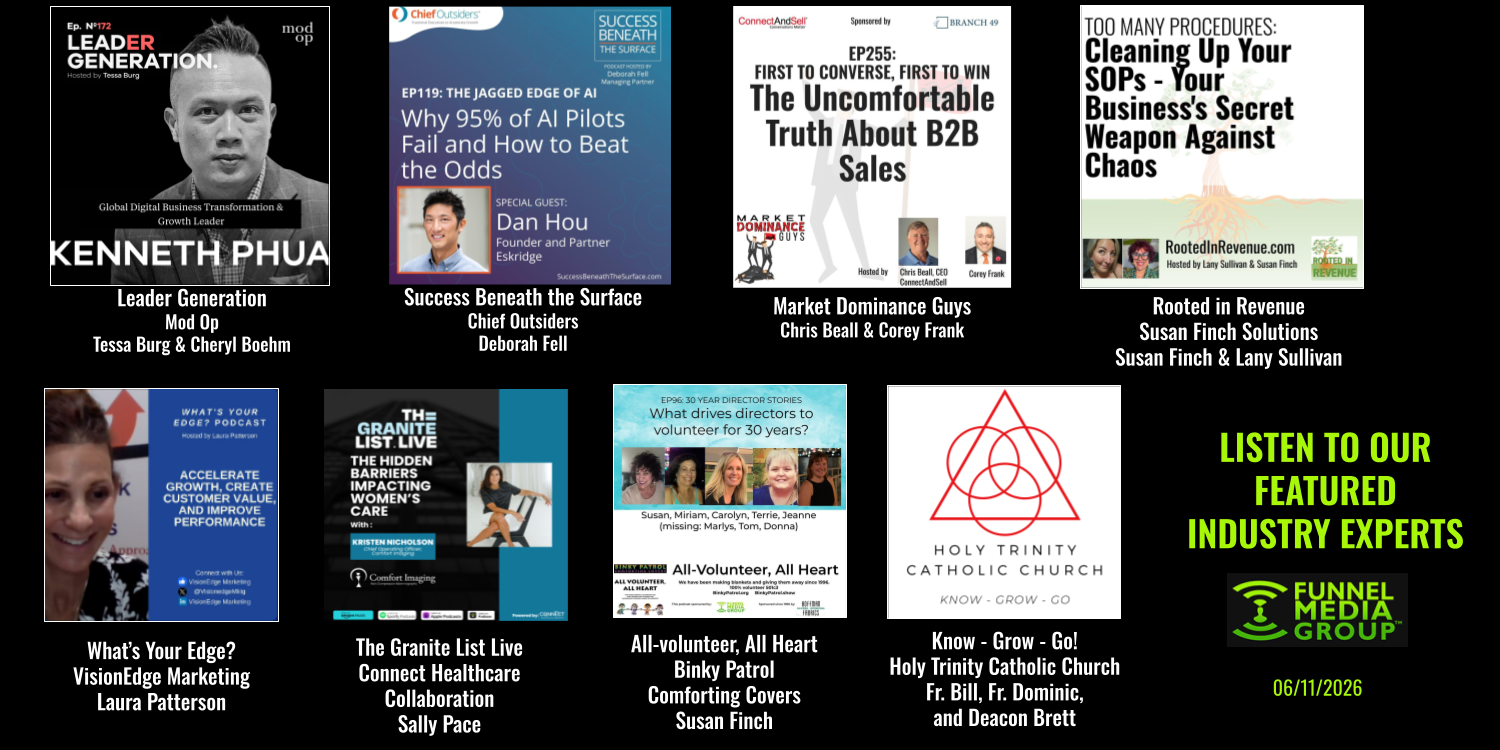
Why do so many promising pilots fail to scale? In this episode of Leader Generation, Tessa Burg talks with digital transformation leader Kenneth Phua to explore what separates successful pilots from initiatives that never move beyond the testing phase. Drawing on his experience leading digital strategy and transformation programs for global brands, Kenneth shares the common mistakes organizations make when measuring pilot success, why repeatability matters more than one-time wins, and how businesses can build the capabilities needed to scale digital and AI initiatives across teams, markets, and functions. The conversation also explores the role of leadership in successful transformation. Kenneth explains why empathy, curiosity, trust, and a willingness to challenge assumptions are essential for leaders navigating rapid technological change. Whether you’re launching a new digital platform, testing an AI-powered solution, or leading enterprise transformation, this episode offers practical insights for turning experimentation into sustainable growth.
After getting “professionally bamboozled” by the iPhone launch while working at Motorola, Dan Hou made himself a promise: catch the next technology wave, but this time, own the outcome. On Success Beneath the Success with Deborah Fell, Dan talks about how that decision led to Eskridge, an AI consultancy built specifically for mid-market companies—the ones competing in the same arenas as enterprise but without McKinsey budgets or tolerance for bloat. We dig into the shift from “what is AI?” conversations in 2023 to tactical implementation pilots today. Dan breaks down the three-part framework his team uses: strategy, implementation, and change management. The change management conversation gets real. Job descriptions are being rewritten. Performance reviews are shifting from “how many times did you use ChatGPT this week?” to “what evidence shows you’re experimenting and adapting?” Teams need budget autonomy within guardrails, not six layers of approval to try a $50/month tool. Dan also tackles the hard question: is AI actually a competitive advantage? His answer—yes in the near term, no in the long term as it commoditizes, but the context and instruction sets you feed it can sustain differentiation. We close with what’s next: portable jet-turbine power generators for data centers and world models that could unlock physical robotics applications by training AI to understand three-dimensional space and physics.
Stop drowning in business chaos – your SOPs are the life raft you need. In this game-changing episode, Susan Finch and Lany Sullivan expose why your team’s knowledge hoarding is sabotaging growth and share their proven system for creating procedures that actually get used. They reveal why writing at a 5th-grade level isn’t dumbing down – it’s smartening up your business operations. From horror stories of employees creating secret binders to success stories of businesses transformed through proper documentation, this episode delivers the blueprint for organizing years of scattered procedures into one powerful system. Learn the exact folder structure, naming conventions, and review processes that turn procedural chaos into operational clarity. Whether you’re a solopreneur ready to scale or managing a team that’s reinventing the wheel daily, this episode provides the roadmap to document, delegate, and finally find joy in your work again.
Here is a truly special episode of Market Dominance Guys. Today, Chris Beall flies solo while co-host Corey Frank is busy scaling his powerhouse conversationalist team at Branch 49 down in Phoenix – where business is as hot as the July desert sun. In this unique episode, Chris gives us an exclusive preview of his upcoming book “First to Converse: Dominate Markets with the Human Voice,” set to release in fall 2025. This isn’t just another sales book – it’s a comprehensive cookbook for market dominance, designed for everyone from CEOs and founders to individual sales contributors who understand that whoever is first to converse is first to win. Chris takes us through the book’s introduction, sharing the uncomfortable truth that while everyone thinks buyers want to control the sales process, the reality is that the first company to engage a prospect in meaningful conversation shapes their entire buying journey. Drawing from over 14 years of experience leading ConnectAndSell, Chris reveals why cold calling remains the strongest foundation for B2B success – and why waiting for inbound leads is a losing strategy. This episode serves as both a dry run for the audiobook version and a masterclass in why targeted conversations at pace and scale dominate markets. So buckle up as Chris challenges everything you think you know about modern B2B sales.
Most of us are wrestling with change. Whether it’s because of accelerating technology cycles, disruptive technologies challenging established models, competitive pressures intensifying, or something else, we risk becoming dinosaurs. On this episode of What’s Your Edge? with Laura Patterson and guest Dave Work, they ask how do you future-proof your company, and what does that mean? For leaders and boards alike, this question has become less about optional innovation and more about long-term relevance, risk management, and enterprise resilience. The companies that anticipate change, embrace innovation, and most importantly keep their customers at the center of every decision are in a better position to survive and thrive. Future proofing is about building resilience and agility so your organization can adapt, grow, and stay relevant. No matter what the market throws your way. Future-proofing isn’t about predicting exactly what will happen next. It’s about creating the capacity to respond when it does. For customer-centric companies, the answers to tomorrow’s challenges are often hiding in plain sight: in the very pain points, feedback, and unmet needs of the customers you serve. And that’s what we’re going to explore today in our conversation with Dave Work, Managing Partner of Diversicom Corporation, a Managed Service Provider (MSP). MSPs act as an outsourced IT department for businesses, which typically provides managing IT infrastructure, cybersecurity, network management, and cloud support.
Four Binky Patrol directors — Miriam Siegel (Nebraska), Carolyn Berndt (Thousand Oaks), Terrie Madruga (Idaho), and Jeanne Malgioglio (Connecticut) — join founder Susan Finch for a 30th anniversary conversation that is equal parts laughter, tears, and gratitude. “I’m here to help. Can’t sew, but here I am.” — Carolyn Berndt, arriving eight months pregnant to her first Binky meeting. You’ll hear Miriam’s story of finding a tiny newspaper ad and calling her mom instantly. Carolyn showed up eight months pregnant, unable to cut a straight line, and becoming a public speaking powerhouse. Terrie turning “I have no talent” into every volunteer having a title and a purpose. And Jeanne — the newest director — already mastering the art of moving 500 blankets across the country on donated trucks. Missing today but never forgotten: Tom, Marlys, and Donna Serra — each one a quiet, steady force behind the mission. This one will make you cry. In the best way.
This week on Granite List Live, Sally Pace is joined by Kristen Nicholson, Chief Operating Officer of Comfort Imaging, as they dive into the barriers women face when trying to access a crucial aspect of care. Despite rapid advancements across healthcare, traditional mammography has remained stagnant for over 25 years, causing women to delay care due to discomfort and fear. Kristen shares how Comfort Imaging is creating a better mammography experience for women with their innovative Koning Vera Breast CT Technology, designed to deliver faster, more accurate, and more comfortable screening. Combined with an individualized, guided patient experience, Kristen details how Comfort Imaging removes traditional barriers to care, motivating women to engage in crucial preventative care earlier and more consistently.
Lastly, Father Deacon says the way to protect our hearts from ever being broken is to seal them off and never take the risk of love; to close ourselves off. And that is the opposite of what the Trinity is. The Trinity is outpouring, complete self-giving. And that means being broken. It means taking a risk. Love means we are going to be hurt, but love doesn’t care. Love is willing to take the risk. And love knows that life is better, that everything is better, when we pour ourselves out in love, even though that is painful and difficult.
We hope you enjoy this playlist of our favorite episodes of the week!