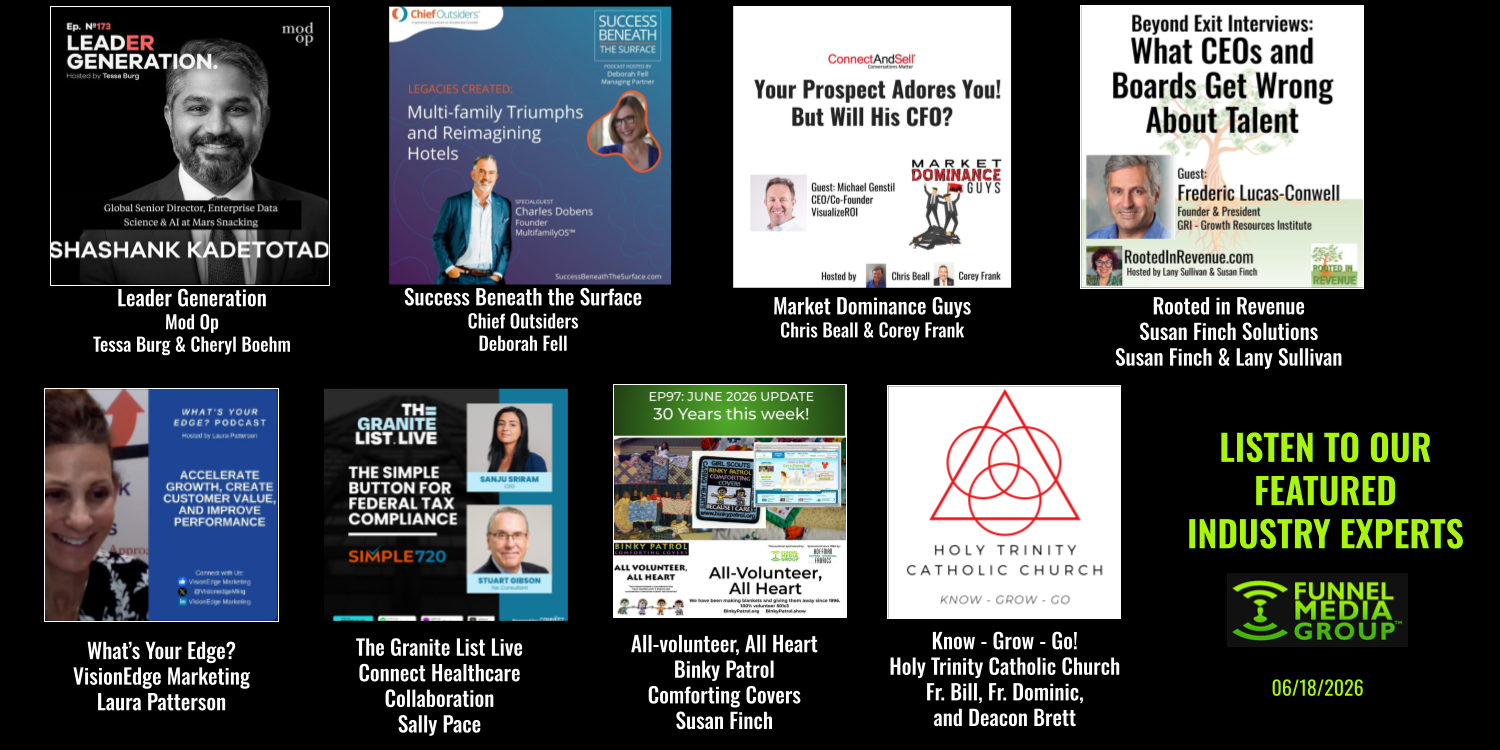
Coming up with AI ideas isn’t the struggle for most teams. The real challenge is to make those ideas stick. In this episode of Leader Generation, Shashank Kadetotad, Global Senior Director of Enterprise Data Science and AI at Mars, breaks down what helps companies move from interesting pilots to real business impact. He explains why adoption matters just as much as the technology itself, how culture and leadership shape success, and why the best AI solution is not always the most complex one. You’ll get practical advice on involving the right users early, setting clear success and failure criteria for pilots, and deciding when to build versus buy. Shashank shares lessons from leading AI work inside major organizations and offers a grounded view of what it takes to scale responsibly. If your team is trying to get more value from AI, this conversation will give you a clearer and more useful way to think about the work.
Charles Dobens joins Deborah Fell on Success Beneath the Surface. He delves into his multifaceted journey and shares his expertise in real estate investing and business growth. As a teen, Charles had a dream to own apartment buildings. With a side journey into law, this is precisely what he has done. In the first half of this episode, Charles discusses how he identifies opportunities amidst roadblocks. From overcoming hurdles to staying the course, his experiences shed light on the tenacity required for success. In the second half, the conversation shifts to Charles’ diverse range of business ventures. He emphasizes the power of listening to advice and learning from experts, while his Multifamily Investing Academy takes center stage. His innovative approach to creating business systems and tackling challenges head-on is evident, alongside his passion for helping others navigate the complex world of real estate.
Are you losing your best people and don’t know why? In this final episode of our Rooted in Revenue four-part series with Frederic Lucas-Conwell, founder of GRI.co, we tackle the most expensive problem in business: top talent walking out the door. Most companies think they understand why high performers leave. They’re wrong. From boardroom battles to manager missteps, Frederic reveals the behavioral mismatches that drive your best people away—and the surprisingly simple changes that can keep them engaged. We discuss why CEOs and boards clash despite shared goals, what “engagement” really means (hint: it’s not what most tools measure), and the one overlooked factor that matters more than perks, ping pong tables, or pizza Fridays. If you’re tired of expensive turnover, bland exit interviews, and watching talent walk to your competitors, this episode delivers actionable insights you can use this week. No fluff, no corporate speak—just honest conversation about what actually works.
Every single thing that happens in sales is about learning — on both parties’ parts — and this includes presenting and discussing value metrics with prospects and with customers who are up for renewal. What works best? Adopting an attitude of rampant optimism or one of friendly skepticism? Should the value metrics you present be the same, or should they vary when you’re talking with inbound prospects versus outbound prospects? Is it most effective to emphasize only one appealing value, or is it better to trot out several beneficial metrics? In this third Market Dominance Guys’ conversation between Chris, Corey, and Mike Genstil, co-founder and CEO of VisualizeROI, this trio of experts discusses how to price your company’s offering, how to handle discount requests, and what to do about a prospect’s fixed-budget limitations. Most importantly, they delve into the reality of what happens when you have successfully convinced a prospect of the value of your offering — to the extent that he is now a champion of your product or service — but when he carries your banner back to his company, he is faced with a bunch of skeptics who haven’t had the benefit of hearing your pitch. Since 98.3% of all sales decisions are fought internally, you’ll want to hear the strategy Chris, Corey, and Mike suggest for arming your prospect with the value metrics that will help him win that battle.
Most of us are wrestling with change. Whether it’s because of accelerating technology cycles, disruptive technologies challenging established models, competitive pressures intensifying, or something else, we risk becoming dinosaurs. On this episode of What’s Your Edge? with Laura Patterson and guest Dave Work, they ask how do you future-proof your company, and what does that mean? For leaders and boards alike, this question has become less about optional innovation and more about long-term relevance, risk management, and enterprise resilience. The companies that anticipate change, embrace innovation, and most importantly keep their customers at the center of every decision are in a better position to survive and thrive. Future proofing is about building resilience and agility so your organization can adapt, grow, and stay relevant. No matter what the market throws your way. Future-proofing isn’t about predicting exactly what will happen next. It’s about creating the capacity to respond when it does. For customer-centric companies, the answers to tomorrow’s challenges are often hiding in plain sight: in the very pain points, feedback, and unmet needs of the customers you serve. And that’s what we’re going to explore today in our conversation with Dave Work, Managing Partner of Diversicom Corporation, a Managed Service Provider (MSP). MSPs act as an outsourced IT department for businesses, which typically provides managing IT infrastructure, cybersecurity, network management, and cloud support.
It’s Binky Patrol’s 30th anniversary. Susan Finch marks the week with a look back at how one mention on The Oprah Winfrey Show launched the organization into 48 states almost overnight. She invites every chapter and supporter to celebrate this Saturday, gather friends, finish a stash project or a UFO, and send photos of how they marked the milestone. Susan also introduces Comforting in Color, a flexible new project that any group, school, church, or business can run. Plus a look back at three decades of memories: golf tournaments, a summer of community quilting at a Wells Fargo branch, the Founder’s Day Parade, braille binkies for blind children, and two throwback clips revisiting the chaos and joy of Disney’s Give a Day Get a Day program and a massive Girl Scout troop blanket drive. Thank you to the national partners who made 30 years possible.
Federal tax compliance in employee benefits is not optional; however, it does not have to be complicated. This week, host Sally Pace is joined by Sanju Sriram, CEO of Simple720, and Stuart Gibson, Tax Consultant, as they dive into one of the growing pain points in benefits administration – federal tax and reporting compliance. With PCORI fees (Form 720), ACA reporting, Form 5500 filings, and Department of Labor requirements placing a significant burden on HR teams, Sanju and Stuart outline how the Simple720 solution works to turn hours and days of work into just a few minutes.
Finishing up with some words from the Holy Trinity Church. Christ is not inviting us to excess or self-indulgence, but in making Himself bread and wine, He is blessing the ordinary and the extraordinary. Sustenance and celebration. He comes to us through symbols of the fullness of life in every stage and season. And these elements of bread and wine become not only our life-giving food, but much more. When we eat this bread and drink this wine, we receive Christ’s life – the life of the Trinity that is self-giving, self-emptying love, a love that gives everything and contains all suffering and sorrow as well as all happiness and joy.
We hope you enjoy this playlist of our favorite episodes of the week!